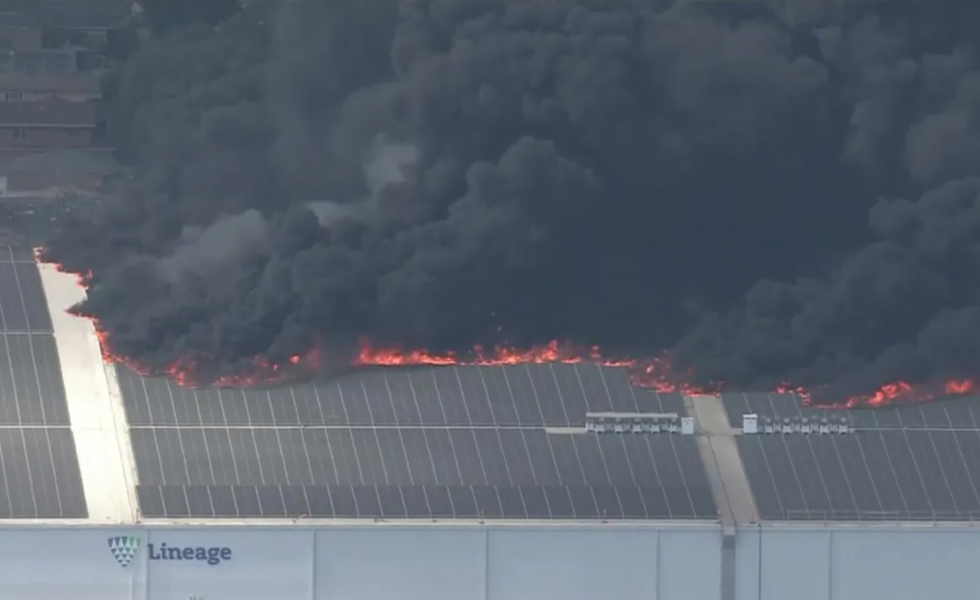
En apenas medio mes, tres grandes incendios han arrasado tejados en tres países diferentes. Recientemente, tres incendios aparentemente no relacionados—uno en una planta química nacional, uno en un almacén de cadena de frío al otro lado del océano y otro en un edificio residencial europeo—todos apuntaron a módulos fotovoltaicos (PV) en azoteas. Con la llegada del verano, una temporada de máximo riesgo de incendios, los incendios de PV en azoteas están evolucionando de incidentes aislados a un nuevo tipo de incendio cada vez más frecuente en fábricas y edificios, afectando silenciosamente a toda la industria PV.
¿Por qué un módulo PV, destinado a generar electricidad de forma silenciosa, se vería involucrado en un incendio? El análisis de las consecuencias de estos tres incidentes revela que sus costes son mucho mayores que simplemente «prenderse fuego».
El 13 de junio se declaró un incendio en el patio de materiales de parafina de la planta Yanggu Huatai Yanggu. Una densa columna de humo negro se elevó decenas de metros, acompañada de múltiples explosiones. El incendio tardó varias horas en ser controlado, con el resultado de tres heridos. Esta fábrica es la base de producción principal de la empresa. La producción se suspendió inmediatamente después del incendio, y la empresa anunció que tendría un impacto significativo en su desempeño de 2026. El precio de las acciones también sufrió una fuerte caída de más del 10% en el mercado secundario. Hasta ahora, la causa del incendio sigue bajo investigación, pero las fotos del lugar muestran que los módulos fotovoltaicos a gran escala instalados en el tejado del almacén se incendiaron simultáneamente, volviendo a poner en el foco la relación entre los módulos fotovoltaicos y los incendios en edificios.
Al otro lado del océano, el 17 de junio se declaró un incendio en un almacén de cadena de frío de 46.000 metros cuadrados perteneciente a Lineage Logistics, un gigante mundial de la cadena de frío, en Boyle Heights, Los Ángeles. Según declaraciones de los inquilinos, un contratista externo estaba probando un conjunto fotovoltaico en el tejado cuando comenzó el incendio, y las investigaciones preliminares sugieren que este trabajo podría haber sido el desencadenante. Simultáneamente con el sistema fotovoltaico en azotea incendiándose, las tuberías de amoníaco dentro del edificio también se vieron afectadas y se rompieron, provocando múltiples explosiones. El departamento de bomberos emitió una orden de evacuación y el gobernador de California declaró el estado de emergencia. El incendio ardió durante varios días y, al quinto día, aún no se había extinguido por completo.
Al mismo tiempo, los tejados residenciales en Europa también resultaron dañados. El 9 de junio se declaró un incendio en un edificio residencial en Clervo, Alemania, que se propagó al tejado. Debido a que el tejado estaba construido con módulos fotovoltaicos combinados con cubiertas verdes, que se electrifican cuando están expuestos a la luz solar, se desplegaron 42 bomberos, y la labor de extinción en el tejado duró aproximadamente 5 horas. En los últimos meses, Alemania ha registrado una serie de incendios en tejados residenciales con energía solar. En un incidente, un bombero sufrió una descarga eléctrica y fue hospitalizado mientras desmontaba el tejado para combatir el incendio, porque los módulos fotovoltaicos seguían electrificados.
En estos casos, los módulos fotovoltaicos a veces son la causa del incendio y a veces una variable que permite que el fuego se propague. Pero, independientemente de su papel, una señal es clara: a medida que la energía solar distribuida se instala rápidamente en fábricas, almacenes y residencias, la seguridad de los módulos ya no es solo un asunto de fabricación de productos; es un desafío que la seguridad de los edificios, la seguridad de la producción y la operación y mantenimiento posterior deben abordar.
Peligros ocultos en capas: los incendios de módulos son mucho más que un «incendio»
Basado en información de accidentes disponible públicamente y análisis de la industria, el riesgo de incendio de las centrales fotovoltaicas (PV) distribuidas suele derivarse de una combinación de factores. Entre los desencadenantes comunes se incluyen los efectos de puntos calientes y el arco de corriente continua (DC). Los problemas de calidad también son un factor que contribuye a los incendios PV.
Un punto caliente, en pocas palabras, es «un desastre causado por una sombra». Cuando la superficie de un módulo está obstruida por excrementos de aves, hojas caídas o polvo acumulado, las células ocultas no pueden generar electricidad con normalidad. En su lugar, actúan como una carga, consumiendo energía de otras células, lo que provoca un aumento rápido de la temperatura local. Esto puede acelerar el envejecimiento del módulo o, en casos graves, encender directamente los materiales circundantes.sistema PV suele ser típicamente de hasta 600 a 1000 voltios. Las conexiones sueltas, los cables dañados o el deterioro del aislamiento pueden generar arcos, y los arcos sostenidos pueden alcanzar temperaturas de 3000 a 7000 °C, suficientes para carbonizar instantáneamente los componentes, atravesar el acero estructural y propagarse al espacio inferior. Una central eléctrica tiene cientos o incluso miles de conexiones; una sola conexión suelta puede convertirse en una fuente de incendio.
Más allá de los riesgos tecnológicos, los problemas de calidad inherentes a la industria están amplificando el riesgo general. En un seminario de la industria fotovoltaica en 2025, un experto del sector afirmó sin rodeos: «En los últimos dos años, las empresas han estado vendiendo a pérdida, haciendo que las obleas de silicio, los marcos, el vidrio y las láminas de encapsulado sean cada vez más delgados. Ya no hay elasticidad; ¿cómo no van a surgir problemas?». Esto no es alarmismo: los datos del Centro Nacional de Inspección y Ensayo de Calidad de Productos Fotovoltaicos muestran que la tasa global de aprobación de los módulos fotovoltaicos ha disminuido del 100% en 2019 al 62,9% en 2024, con la tasa de aprobación de materiales auxiliares clave como las cintas de soldadura y las cajas de conexión cayendo incluso por debajo del 50%. La falsificación de la potencia nominal y el adelgazamiento de materiales pueden parecer medidas de reducción de costes a corto plazo, pero a largo plazo podrían traducirse en menor generación de energía, puntos calientes e incluso riesgos de incendio.
El aspecto verdaderamente problemático de los incendios fotovoltaicos no suele ser el incendio en sí, sino los componentes eléctricos. Los bomberos suelen descubrir al llegar que el tejado no puede desmontarse directamente—está cubierto de paneles solares que generan electricidad mientras haya luz solar, manteniendo un voltaje continuo de corriente continua de alta tensión durante el día, a diferencia de la corriente alterna que puede cortarse fácilmente con solo apagar el interruptor principal. Usar agua para extinguir el incendio puede provocar salpicaduras al entrar en contacto con materiales inflamables como la parafina, aumentando en realidad el riesgo. Además, la presencia de paneles solares altera la forma de propagación del fuego, haciendo que las tácticas convencionales de extinción resulten a menudo ineficaces. Expertos del sector de bomberos y energía solar admiten que la dificultad de rescatar personas en incendios en tejados solares ha sido subestimada durante mucho tiempo, y la industria aún carece de planes de rescate maduros y ejecutables.
Por eso la National Fire Protection Association (NFPA) en los Estados Unidos exige específicamente sistemas fotovoltaicos (PV) en azoteas para estar equipados con dispositivos de apagado rápido en NEC 690.12, que deben reducir el voltaje fuera del límite del conjunto a menos de 30 voltios en 30 segundos tras su activación para proteger a los bomberos que trabajan en el tejado. Alemania promueve la instalación de «interruptores de extinción de incendios» mediante normas como VDE-AR-E 2100-712. Muchos mercados, incluidos Estados Unidos, Australia, Europa y Japón, han hecho que el apagado rápido a nivel de módulo sea obligatorio o explícitamente requerido. En China, la Administración Nacional de Energía también exige que los proyectos PV distribuidos instalen interruptores de circuito por falla de arco (AFCI) o utilicen módulos con funciones correspondientes. Todos los países apuntan al mismo principio: en incendios relacionados con PV, el elemento más letal suele ser la «electricidad», no solo el «fuego» en sí.
Las capacidades de seguridad primero: pasar de los módulos de «unidades de generación de energía» a «terminales de protección»
Si los casos de incendios exponen los resultados, los puntos calientes, el arco eléctrico y las fluctuaciones de calidad señalan el proceso de formación del riesgo. Por lo tanto, la seguridad PV no puede depender únicamente de la investigación y la rendición de cuentas posteriores a los accidentes. Un enfoque más realista es incorporar las capacidades de seguridad en el diseño y la gestión operativa de los componentes y las centrales eléctricas, permitiendo que los riesgos se identifiquen, localicen y aborden en una fase temprana.seguridad PV en azoteas no puede depender únicamente de la investigación y la rendición de cuentas posteriores a los accidentes. Un enfoque más realista es incorporar capacidades de seguridad en el diseño y la gestión operativa de los componentes y las centrales eléctricas, permitiendo que los riesgos se identifiquen, localicen y aborden en una fase temprana. En última instancia, esto significa pasar de la «extinción de incendios» a la «prevención de incendios», apagando los posibles peligros antes de que se conviertan en incendios.
En la exploración de la industria, la tecnología de seguridad de los componentes está pasando de una protección pasiva a una activa. Áreas como la detección de arcos AFCI, el apagado rápido a nivel de componente, la monitorización del aislamiento, el diagnóstico de puntos calientes y el encapsulado ignífugo están siendo objeto de debate. Recientemente, los componentes inteligentes 5S de Sungrow Power se centran en la «autodiagnosis» y la «autoapagado»: el primero recopila datos operativos en tiempo real como el voltaje, la corriente y la temperatura del componente, permitiendo identificar y localizar riesgos de incendio como arcos y puntos calientes antes de que se inicien; el segundo enfatiza el apagado de seguridad dual a nivel de componente y sistema, cortando rápidamente la alta tensión de corriente continua en situaciones de fallo o extremas, bloqueando el riesgo de incendios eléctricos y su propagación desde el origen, y reduciendo el voltaje de toda la planta a un nivel seguro en 25 segundos. Integrar la detección de anomalías y el apagado rápido en los propios módulos los transforma de «unidades de generación de energía» pasivas en «terminales de seguridad» proactivas.
Desde plantas químicas hasta almacenes de cadena de frío, y luego hasta tejados residenciales, tres grandes incendios en medio mes sirven de advertencia a la industria fotovoltaica en rápido crecimiento: a medida que los sistemas fotovoltaicos distribuidos se despliegan en los tejados de diversas industrias, esta rápida expansión no puede descuidar la garantía más fundamental de la seguridad. Objetivamente, los incendios en centrales fotovoltaicas son esencialmente eventos probabilísticos, que a menudo resultan de defectos de calidad, una construcción y mantenimiento inadecuados o una combinación de condiciones operativas extremas, más que de un defecto inherente del sistema fotovoltaico en sí. Precisamente porque se trata de un riesgo probabilístico predecible y controlable, incorporar medidas de seguridad en los productos de antemano y proporcionar «seguro de seguridad» para cada tejado y cada central eléctrica demuestra su valor a largo plazo.