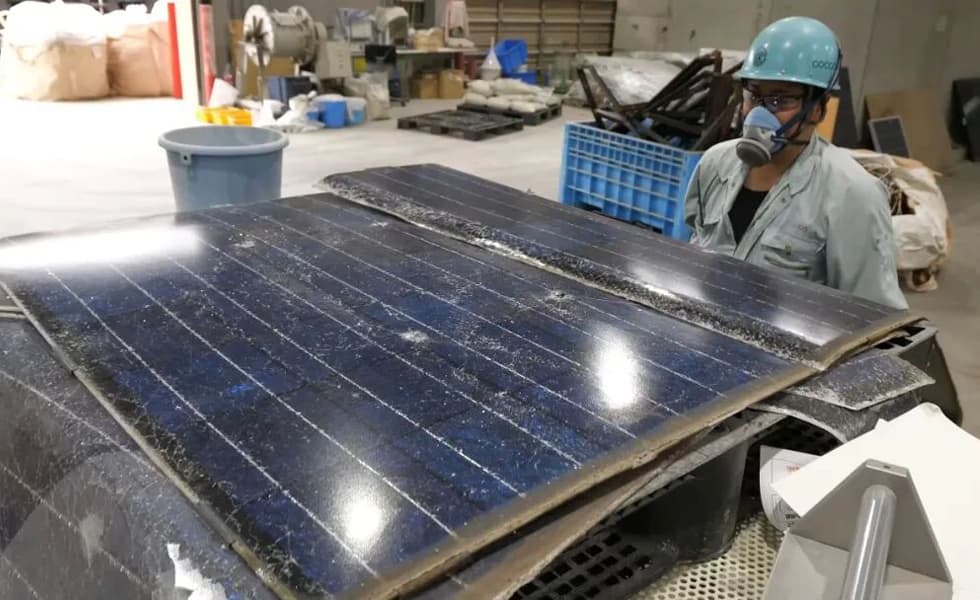
Photovoltaic (PV) modules—one of the "new three" key product categories (alongside power batteries and wind turbine blades)—have now been officially incorporated into the national management system for the recycling of renewable resources.
On November 17, nine government departments, including the Ministry of Commerce, jointly issued the Opinions on Further Advancing the Development of a Renewable Resource Recycling System and Promoting High-Quality Growth in the Recycling Industry. The document includes a dedicated section outlining plans for the recycling and dismantling of solid waste from these "new three" categories: power batteries, PV modules, and wind turbine blades.
It explicitly calls for the establishment of a robust system for the recycling and dismantling of decommissioned PV modules. It encourages state-owned power enterprises to develop market-based operational partnerships with specialized recycling and utilization firms, while also urging power generation companies to set up their own systems for recovering decommissioned equipment.
This policy initiative comes in anticipation of an impending, large-scale wave of equipment decommissioning. According to the PV Recycling Industry Development Cooperation Center under the China Green Supply Chain Alliance, the cumulative volume of decommissioned PV modules in China is projected to reach 4 million tons by 2030—a recycling market valued at approximately 26 billion yuan. By 2050, these figures are expected to climb to 23 million tons and 420 billion yuan, respectively.
As the scale continues to expand, this recycling market—starting in the realm of millions of tons—is shifting from a long-term environmental concern into a pressing, practical challenge that the entire industrial chain must now confront.
I. Clearing Bottlenecks in Supply: Moving Toward Standardized PV Module Recycling
Over the past few years, China has introduced a number of policies regarding PV recycling. From the initial framework of responsibilities proposed by various departments in 2023 to subsequent supporting documents that provided guidance on technical pathways and pilot demonstrations, these policies have largely focused on internal industry dynamics, emphasizing the principles and technical directions for circular utilization.
What distinguishes this latest document is that it integrates PV recycling—previously treated as a niche circular economy track for new energy—into the broader national framework for renewable resource recycling. Crucially, it addresses long-standing shortcomings by focusing on the upstream sourcing of materials and the strategic layout of recycling networks.
The primary challenge in recycling decommissioned PV modules is not a lack of dismantling technology; rather, it lies in the highly fragmented nature of the supply and the chaotic, disorganized channels through which these materials circulate. On one hand, large-scale domestic photovoltaic (PV) power plant assets are primarily concentrated in the hands of centrally-administered state-owned enterprises (SOEs) in the power sector, where the process for decommissioning and disposing of major equipment involves a long chain of steps and numerous approval requirements. Meanwhile, while distributed PV projects are numerous and widespread, they are characterized by small individual scales and high costs associated with aggregating assets across different regions.
On the other hand, there is a significant disconnect between supply and demand. Legitimate dismantling enterprises struggle to secure a stable supply of decommissioned modules, leading to chronic underutilization of their production lines; conversely, unregulated "gray market" channels—operating outside of official oversight—intercept these materials by leveraging lower costs.
The policy document proposes establishing a market-based connection mechanism between central SOEs and recycling firms, specifically targeting this bottleneck. By creating stable cooperative channels, the policy aims to facilitate the flow of decommissioned modules from power plants to recyclers, ensuring a consistent supply of raw materials and curbing the disorganized outflow of these components at the source.
However, securing a "source of supply" is merely the first step. A well-functioning recycling industry also requires a viable economic model.
Currently, many power plant operators remain in a "wait-and-see" mode. Key questions persist: Can the costs of disposing of decommissioned modules be integrated into routine operations and maintenance (O&M) budgets? Who should bear the costs of transporting and dismantling modules from remote locations? More crucially, can the silicon, aluminum, and glass recovered through recycling be seamlessly reintegrated into the PV manufacturing supply chain?
Until detailed supporting regulations—such as cost-sharing frameworks and financial instruments—are implemented, these practical challenges will continue to confront enterprises.
For PV module manufacturers, this policy shift also sends a clear signal: as the recycling ecosystem matures, future module design must look beyond power generation efficiency and manufacturing costs to also consider the ease with which materials can be dismantled.
In the future, R&D for PV modules will increasingly prioritize not only efficiency and cost reduction but also material selection and packaging structures that facilitate subsequent separation and recycling. A closed-loop management system covering the entire lifecycle of PV products—from factory output and power plant operation to decommissioning, dismantling, and material recovery—is rapidly taking shape.
II. Grading Before Dismantling: A Tiered Approach to Decommissioned Modules
The decommissioning of a PV module does not necessarily mean it must be sent directly to a dismantling line. Faced with an ever-growing stock of existing assets, the industry is moving away from a "one-size-fits-all" approach toward a tiered management strategy: first assessing the health of individual modules, then determining whether they should be repurposed (cascaded use) or dismantled for material recovery.
Many modules retired ahead of schedule are not entirely non-functional. Often, they are taken offline due to power plant technical upgrades, site relocations, or optimizations of the capacity-to-inverter ratio; the cells themselves show limited degradation and retain significant power-generation capacity. Dismantling such modules immediately would mean wasting their remaining utility.
Through professional screening and testing, these modules can be repurposed for applications such as off-grid residential power supply, small-scale energy storage, or basic power provision in remote areas—a far more cost-effective solution.
However, this "cascaded use" business model faces practical hurdles.
The market is flooded with a vast array of module models from different years, with incompatible technical specifications and warranty standards across manufacturers. Establishing a reliable system for testing, sorting, and repackaging requires highly standardized processes.
Even more challenging is the lack of unified industry standards regarding quality traceability, long-term operation and maintenance (O&M), and the allocation of safety liability for repurposed modules.
If second-hand modules entering the market harbor hidden defects—such as "hot spots" or insulation failures—they could easily trigger safety incidents, thereby damaging the reputation of the entire cascaded-use sector.
Only modules that have degraded severely or sustained physical damage to the point of being unable to generate power are sent for material dismantling. This implies that the recycling industry cannot focus solely on shredding and refining equipment; capabilities in testing, sorting, and grading are equally critical links in the value chain.
In fact, this refined approach to asset management is reshaping the investment logic for power plant operators. Previously, when calculating returns, operators typically focused only on the construction and operational phases, while end-of-life disposal was often dismissed as the mere handling of scrap decades down the line.
Under the new policy framework, however, the retirement of a power plant is no longer the end of an asset's lifecycle, but rather a new starting point for extracting further value. From the initial planning stage, owners must now incorporate future module grading, circulation, and disposal strategies into their full-lifecycle financial projections. Naturally, a reasonable boundary must be established between "second-life" utilization (repurposing) and direct dismantling. Over-reliance on secondary markets—allowing a large volume of aging components to circulate indefinitely—merely defers safety hazards and environmental burdens. Conversely, opting exclusively for direct dismantling would result in a waste of resources.
Defining clear criteria to strike a balance between extracting residual value and managing long-term risks is a challenge that subsequent supporting regulations must address.
III. Long-term Strategic Planning: Building a Green, Closed-Loop Lifecycle for the Photovoltaic Industry
As the development of supporting management policies accelerates, the regulatory framework for photovoltaic (PV) recycling will continue to be refined. Beyond domestic circulation, the industry must also confront the risks posed by the unregulated outflow of used components; it is essential to standardize cross-border movement and uphold the fundamental principles of green trade.
In fact, the primary value of this policy document lies not in the immediate revenue it might generate for the PV recycling sector, but in its establishment of a long-term, collaborative governance approach. By leveraging regional recycling hubs and robust traceability systems, the PV industry will gradually ensure that recycling responsibilities are effectively assigned to the relevant market participants.
From a phase of rapid capacity expansion to one that now accounts for end-of-life disposal, the PV industry is undergoing a fundamental shift in perspective. A mature recycling system is not only a necessary preparation for the impending wave of decommissioned assets, but also a vital foundation that will empower the industry to continue its global expansion and navigate through market cycles.